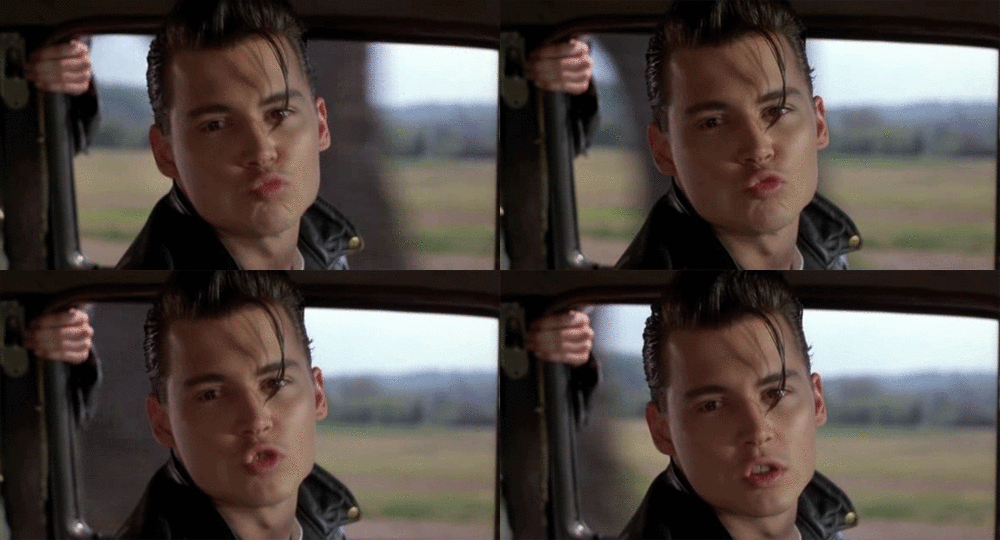
This is our Preliminary task:
"Continuity task involving filming and editing a character opening a door, crossing a room and sitting down in a chair opposite another character, with whom he/she exchanges a couple of lines of dialogue. This task should demonstrate match on action, shot/reverse shot and the 180 degree rule.
I worked in a group with Phil, Matt and Kayla to complete this. We decided on the idea of a strange man purchasing a keyboard in a music shop.
This was our first real opportunity to use the cameras to film and then the editing software in post-production, we had very limited knowledge on film at this point.
We decided to edit Emma's parts of the opening on black and white, this was to expand on the contrast of the boy and girl. i found it quite difficult to find a film what has a black and white scene in it while all the rest of the film is in colour. In James Bond Casino Royale the opening few minutes is a black and white fighting scene, this was a great example as it was at the start of the film, which is what we have to create, here is the video.
This is our storyboard of our movie, its very brief but gives us a simple idea of what is happening throughout, we need to have a variety of shots to keep it interesting, and shots will be different lengths, the average shot length is 3 seconds.
Establishing Shot: A shot taken from an overhead position, often used as an establishing shot.
Close up shot: A head and shoulders shot often to show expression or emotion of a character. Also can be a shot of an object, filmed from close to the object or zoomed in that reveals detail.
Extreme Close up: A shot where part of a face or body of a character fills the whole frame, also can be a shot of an object where only a small part of it dominates the frame.
Establishing Shot: A shot that establishes a scene, often giving their viewer information about where the scene is set. Can be close up shot but often a wide/long shot that usually appears at the beginning of the scene.
Medium Shot: The framing of a subject from waist up.
Two Shot: A shot of two characters, possible engaging in conversation. Usually to signify/establish some sort of relationship.
Point-Of-View Shot: Shows a view from the subjects perspective. This shot is usually edited so that the viewer is aware who's point of view it is.
Over the shoulder Shot- looking behind a characters shoulder, at a subject. The character facing the subject usually occupies 1/3 of the frame but it depends on what meaning the director wants to create (for example, if the subject is an inferior character, the character facing them may take up more of the frame to emphasise this.
Overhead Shot- a type of camera shot in which the camera is positioned above the character, action or object being filmed.
Reaction Shot: a shot that shows the reaction of a character either to another character or an event within the sequence.
Angles
High Angle: a camera angle that looks down upon a subject or object. Often used to make the subject or object appear small or vulnerable.
Low Angle: A camera angle that looks at a subject or object. Often used to make the subject/object appear powerful/dominant.
Canted framing (or oblique): camera angle that makes what is shot appeared to be skewed or titled.
This is an AS media movie opening called Exiled- its a fantasy about a group of boys on a quest, as you can see by the surroundings and their speech. The first few seconds to it set the scene of the countryside there is diagetic sound of the wind. It then cuts to the 4 male characters who are wearing neutral coloured clothing, shirts, waistcoats and mid length shorts, they have no shoes on and sticks. You can tell its set in an unusual world to the ordinary one, maybe a different dimension or just in the far past.
Non-diagetic sound sets in and slowly builds up it fits with the genre as the names of the actors slowly flash up on screen. as the music is playing the boys/men continue with what they are doing- playing an instrument, sitting by the fire, and cooking food. There are various camera angles, from their height, from above, the lighting is dull but fits in well with the time period, the boys are wearing browns and whites, so they stand out from the dark greens and black of the background. They then begin to pack up and continue with the quest, as they get ready there are many quick 1-2 second shots, which is effective as it speeds you the preparation rather than having a wobbling boring long camera shot. The wind is blowing, everything is very natural, outdoors, only non-diagetic sound is current. then as the camera shots change from behind them or besides them, to in front of them the music gets louder and more powerful.
There are various shots which now show more of the surroundings. it switches to a long shot behind them. This is when you see the setting, of a valley surrounded by hills. this movie opening is very much like the hobbit, of the bare feet, costume, sticks, landscape. after other shots of they walking, there is a very long shot of the valley, in the distance landing on the top of the hill is a dragon, it is not obvious but a very good feature, to explain the genre, of fantasy.
Towards the end of the opening, there is speech, this is the only bit of the opening with it, I feel this is very effective because nothing else is really needed to be said, the language they use clearly states its not set in current time, by his clothing and the fact he is the one who speaks, you can infer he is the leader of the group. He is the only one in red to make him stand out.
The last shot is of the middle of the valley, the 4 boys walking and the sun setting. The producer of this edited the dragon, sunset and eagle flying in, this shows skill which fits in with the story.
I would want to go see the rest of this movie as they have executed the opening very well. This is my favourite opening I have seen, the editing, camera shots, overall story is very impressive. This has become very helpful for my decision in what I will do for my coursework as I enjoyed it so much, I will use this as a basis for mine.
Mise-en-Scene in My week with Marilyn Colin Clark, an employee of Sir Laurence Olivier's, documents the tense interaction between Olivier and Marilyn Monroe during the production of The Prince and the Showgirl. Setting: Set in the 1950's and 60's, firstly in a theatre when Colin is watching Marilyn on the screen, there are other people in the theatre surrounding him, also enjoying watching a beautiful women on the screen.Then it goes to a beautiful home, in the English country side, there is lots of greenery around. Its like castle, you can tell the family are well off. Then it goes to busy London, the posh part, with cars, detached buildings which you can tell are higher class. You then go inside on of the buildings, which has alot of wood and posh finery. Lighting: At the start its a spotlight on Marilyn as Colin watches her on screen, the spotlight focuses on her beauty. Then when it switches to outdoors its natural lighting, and then when ever the scene is inside the lighting is indoor lighting. Costume: Very glamorous dresses that Marilyn wears, the men wear suits, everyone is smartly dresses, with fitted clothing, everyone is very well-dressed as they are upper class people.
Acting: At the start there is mainly men in the audience, they are all enjoying being there as they are watching such a beautiful lady on screen. The actors are very well spoken, with clear Britsh accents. Editing: The credits are at the start, they are shown very elegantly like the movie is. It switches from the castle to the London streets then back to the rural landscape. Camera Shots: Panning out, to focus on the large house, then close up on peoples faces to show expression and the mood. When Colin is waiting for a job in films, he waits for hours, so keeps switching what he does, sitting, standing, looking around, each shot lasts for about 2-3 seconds, this is also part of the editing, as it is a wide shot but changes frequently.
Mise-en-Scene in This is England A story about a troubled boy growing up in England, set in 1983. He comes across a few skinheads on his way home from school, after a fight. They become his new best friends even like family. Based on experiences of director Shane Meadows.
Setting: Set in 1983-4, the opening with the credits is England during that time, a montage of the different events happening then. Then the actual movie starts with a young boy of about 11, in his bedroom, his room looks scruffy and messy, like a typical boys room, but there is not wallpaper, the room needs to be redone, its very run down. Then at a school, a shop and the under a bridge where he meets elders (aged 18-20) Lighting: Its old fashioned lighting, as if it was filmed on an 80's camera at the time, it gave the effect of real footage, to add to the effect of the decade. Costume: 80's clothing, lots of denim, bomber jackets, flares, funky patterns. You had your own group style, you could tell who was part of which group.
Acting: The young boy was picked from a large group of boys, the production team went to a school for a few days watching the boys trying to find out who would be best for the part.The one they chose had never done acting before, he has fitted into the role well. The language is appropriate for that time, he has to act alot older than he is, because that is how the main character in the opening is portrayed. In the first 5 minutes there is a fight between the main boy and a rivalled bully. Editing: At the very beginning of the movie there is a montage of the events happening in the 80's, the good, the bad and the ugly parts, and then the credits switch in and out. Camera shots: There are a variety of shots and angles, most of them are wide to show what is going on in each shot, some are closer up to show expression. But the majority of them are wide, long or medium shots.
Mise-en-scene in the opening to The Graduate The Graduate is about a recent college graduate Benjamin Braddock, who is trapped into an affair with Mrs. Robinson who happens to be the wife of his father business partner and then finds himself falling in love with her daughter, Elaine. In Mr Cole's class we studied the opening to 5 different types of movies. I am picking 3 different ones to study, firstly The Graduate. Setting: Its firstly set on an aeroplane, to then it switches to the airport, then its mainly on a travelator, where there is limited movement. Lighting: There is no specific lighting, just indoor normal lighting. Costume: The main character who we focus on, is dressed formally in a suit, the background people are all dressed in normal everyday clothing. Acting: When Braddock is standing on the travelator the acting is very plain, but its extremely good and simple. Sometimes, in this case, minimal acting is most effective. While the passengers are all sitting on the aeroplane, they are all facing forward, some are up straight, others are slouching they look warn out and bored. Dustin Hoffman plays Benjamin Braddock.
Editing: There is low editing apart from switching between the credits of who directed, produced etc, and who actual film opening. Also editing from the name of the movie, Camera Shots: In the first scene there is a 3 second close up on Benjamin Braddock's face then it zooms out to the interior of an aeroplane with passengers sitting around him. Then when he is in the airport you watch him get on the travelator where then the camera shots are panning along with him as he is moving. Then we focus on his suitcase in exactly the same way, following it along the travelator.